

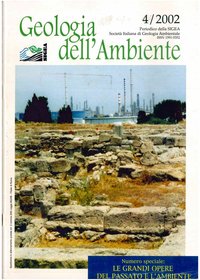
Ricerca 2002 Geologia dell'Ambiente
L’inserimento ambientale di grandi opere del passato
Joann Cassar, Alessandro Ercoli
Abstract
Nowadays, Environmental Impact Assessments are mandatory when it comes to planning large buildings or great infrastructural works. But, looking back at great engineering works of the past, would these have passed such a test? Is it possible that many would never have been built owing to the significant changes brought about in the surroundings? Nevertheless, these structures are today greatly admired masterpieces. Why are they now accepted as an intrinsic part of the environment? Is it because the materials used and forms adopted were ''natural''? Is it because the technology used was not advanced? Or is it because these buildings have now acquired the patina of age? These points are raised by the authors and are discussed in relation to three important case studies from the past: the megalithic temples of Malta, the city of Cyrene in Libya, and the Tawila Water Tanks of Aden (Yemen). The authors suggest that criteria determining the relationship between environment and great civil engineering works in the past may not quite fit in with the modern notion of ''impact''. The authors identify some of the criteria that must be taken into consideration now and in the future. Although the inclusion of great civil engineering works in the natural environment must be subject to rules and regulations, it is however suggested that such projects should not be rejected a priori, considering these as part of a cultural and historical evolution whose roots are deeply embedded in the distant past. I tre casi studio analizzati sono: 1) Templi megalitici delle Isole Maltesi (Ggantija, Hagar Qim, Mnajdra, Tarxien, Skorba, Ta' Hagrat, Hypogeum di Hal Saflieni - IV-III millennio a.C., siti UNESCO 1980-1992) costruiti con Calcare a Globigerine miocenico e Calcare Corallino. 2) Cirene in Libia (VII sec. a.C., Formazione di Derna eocenica): templi di Apollo e Artemide, terme, sbancamenti per terrazzamenti, necropoli su 30 kmq. 3) Tawila Water Tanks ad Aden (Yemen): cisterne pre-islamiche (V-VI sec.) restaurate dagli inglesi nel 1856-1860 con malta 'qadad', capacità 40.000 mc, recupero UNESCO anni '90.
Bibliografia
Bertarelli L.V. (1929) Possedimenti e colonie, Guida d'Italia del Touring Club Italiano, Milano, pp. 489-503; Cassar J. (2000) Conservation studies at the Hal Saflieni Hypogeum 4000BC-2000AD, National Museum of Archaeology, Malta; Ercoli A. (1992) Hal Saflieni Hypogeum Floors and Water Infiltration Problems - UNESCO Report; Ercoli A. (1997) Rehabilitation of Tawila Water Tanks, Aden - UNESCO Report; Grima R. (2001) An iconography of insularity: a cosmological interpretation of some images and spaces in the late Neolithic temples of Malta, Papers from the Institute of Archaeology, UCL, vol. 12, pp. 48-65; Jolinet-Levy C. (1991); Lane M.B. (1990) The Ancient Water Tanks at Al Tawila, Aden - UNESCO/UNDP Report; Lewcock R., Saideh R., Gire J.L. (1980) Conservation, restoration and documentation of archaeological monuments and sites - UNESCO Report; Norris H.T., Penhey F. (1955) An archaeological and historical survey of the Aden tanks, Crown Agents, London; Pace A. (1996) The artistic legacy of small island communities: the case of the Maltese Islands; Pace A. (2000) The Hal Saflieni Hypogeum 4000BC-2000AD, National Museum of Archaeology, Malta; Tampone G., Vannucci S., Cassar J. et al. (1987-1994) I templi megalitici preistorici delle Isole Maltesi.
Localizzazione
Geologia dell'Ambiente, n. 4/2002, pp. 29-35
Libia; Malta; Yemen